
App Development
We build focused web applications, internal tools, and client portals around real workflows.
Build the website your sales process has been missing.
A website should do more than look expensive. It should explain the offer, answer the awkward questions and help the right person take the next step. Most small-business sites fail at the second part. They describe the company and leave the visitor to guess about price, process and fit.
A good web development agency delivers a site that explains your offer, answers buyers’ real questions about price, process, and fit, and makes the next step easy. Fusion Interactive designs and builds bespoke websites in Toronto, with fast pages, search foundations, tested enquiry forms, and editing set up for what your team actually changes. AI features are optional.
We build fast, clear websites that answer real buyer questions and give your team something useful to operate.
We build custom websites around the questions your buyers ask before they contact you. That starts with structure: which pages exist, what each one has to answer and what the visitor should do next. Design comes after, and its job is to carry that structure, not decorate around it.
Adam Growe's site is a good example. You might know Adam from Cash Cab Canada, but an event planner needs to know what happens when he walks into their room. We built Adam's website to show what he brings to an event. Hosting, comedy and his Quiz Show each get their own space, real performance footage does the heavy lifting, and booking routes are never far away. A three-question Room Read quiz gives planners a small taste of the Quiz Boss before they get in touch, and Sanity runs the blog so Adam can publish without a developer.
Fusion Events became our proving ground for sites that take part in the sale. It includes a budget calculator that gives planners a Toronto-market price range for entertainment, an event vibe quiz, act pages with a chat concierge, and location pages for the markets it serves. Those tools exist because they answer questions buyers were already asking, not because a website needs features.
That is the test we apply to every interactive element. A calculator, quiz or chatbot earns its place when it helps someone complete a task. If plain, well-written pages will do the job, that is what we build. AI is available when it serves the brief, and plenty of good websites do not need any.
Under the surface, we build for speed and search. Pages load quickly on a phone, headings and metadata are set up properly, and internal links connect services, examples and next steps. We check forms, redirects and enquiry delivery before launch, because a beautiful page that loses enquiries is worse than a plain one that does not.
After launch, your team should be able to run the site. We set up editing around what you actually change, such as articles, projects, services or team information, and hand over the access and documentation. You keep the keys.
A typical website project starts with the questions, not the pages. We ask what buyers want to know before they call you, what your team explains over and over, and what usually stops a good lead from getting in touch. That becomes a page plan with a job for each page. Design follows, then content and build, and you see working pages before launch rather than a set of static mockups at the end. At the midpoint you review the site as it stands, and we adjust before the remaining pages are finished. We collaborate remotely and can arrange in-person meetings in the GTA when it helps to sit down with the content.
On price, a focused marketing site can fit our Starter tier, $2,500–$5,000 CAD, which typically takes 2–4 weeks. Sites with custom design across many pages, a CMS, interactive tools or integrations usually sit in the Professional tier, $5,000–$15,000 over 4–8 weeks. Larger builds are scoped as Enterprise work from $15,000, typically 8–16+ weeks. Every project starts with a scope, a price and review points.
The questions we work through before quoting, so the first release does one job well.
A visitor rarely arrives wanting to admire a website. They want to understand what you offer, whether you understand their problem, and what happens if they contact you. A good website puts those answers within reach. Design gives the message character, but the message needs to exist first.
We work through your audience, offer, evidence, and sales process before deciding what the pages should look like. That includes the questions your team answers repeatedly, the work you want more of, and the enquiries you need to qualify. Those details shape the navigation, copy, and calls to action.
Some projects need clear service pages, a portfolio, and a dependable enquiry form. Others benefit from booking, a searchable catalogue, a calculator, or a guided questionnaire. The right choice depends on what helps someone make a decision. Adding an AI feature earns its place only when it improves that journey.
Content management belongs in the brief too. Who publishes a case study? Who changes a service description? Which updates need review? We choose the editing setup around the people who will maintain the site. A bespoke design should not leave your team dependent on a developer for every sentence.
For SEO and answer engine optimization, each important page needs a clear subject and an answer worth finding. We organize service information, buyer questions, and real project evidence into readable sections. Descriptive internal links help visitors move from an overview to the detail they need, while headings and structured data make the page easier to interpret.
A rebuild also needs a plan for existing URLs, redirects, image sizes, mobile use, and enquiry tracking. A beautiful launch can still lose useful traffic or break a sales route. We review the working pages and forms before release, then agree on what you will measure after the site goes live.
Bring your current website, examples of work you can show publicly, brand assets, and a few recent sales questions. Tell us which pages already attract useful enquiries. If your positioning or content needs work, say so at the start. Copy and evidence are part of the project, not empty boxes to fill after design.
The scope should identify the pages, content responsibilities, integrations, review rounds, and handoff. Separate the launch requirements from improvements that can follow. You get a clearer quote and a website that can launch with a coherent offer rather than waiting for every possible feature.
Jobs this service is built for. Named projects link to their case studies; the rest are typical starting points, not past results.
We built Adam's website to show what he brings to an event: separate spaces for hosting, comedy and his Quiz Show, real performance footage, a three-question Room Read quiz and booking routes throughout. Sanity runs the blog.
The Fusion Events site gives planners a budget calculator with a Toronto-market price range, an event vibe quiz, act pages with a chat concierge and location pages, so buyers can qualify themselves before the first call.
Kerri Sutey's platform combines service content, booking and a chatbot, so visitors can learn, ask and book in one place.
An existing site that describes the company but not the offer is restructured around services, examples, pricing signals and a clear next step, keeping the URLs and content worth keeping.
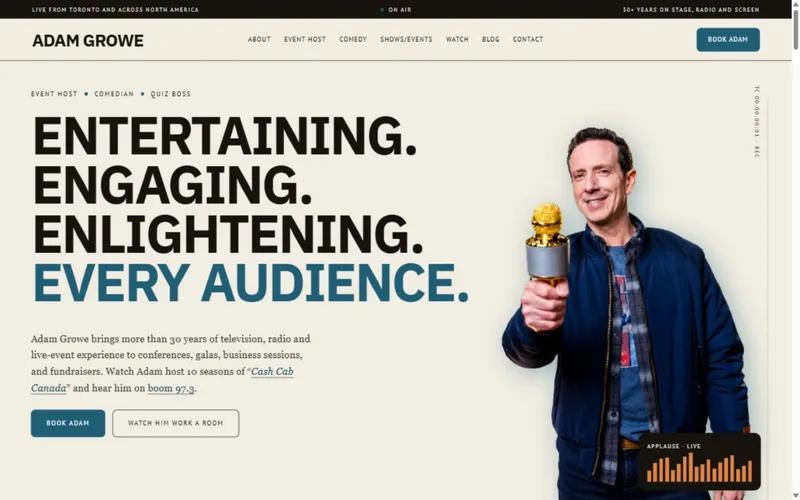
Adam Growe
Entertainment · Personal Brand
A custom website for the host of Cash Cab Canada, built around the person, the performances, and the next booking conversation.
Read the Adam Growe case studyDefine the audience, offer, page structure, and evidence. Identify who supplies content and approves it. Review important existing URLs and the editing requirements.
Develop the visual direction and key page journeys. Review the actual content and responsive layouts while changes are practical.
Connect the agreed CMS, forms, and features. Check mobile use, redirects, metadata, and enquiry delivery before the authorized release.
Give your team the agreed access, documentation, and editor guidance. Define who maintains content and how technical support works after launch.
Our project tiers are Starter at $2,500–$5,000 CAD, Professional at $5,000–$15,000 and Enterprise at $15,000+. A focused marketing site can fit Starter; fully custom marketing websites start at $8,000, and web applications with complex functionality run $15,000 and up. You get a price before work begins.
Starter projects typically take 2–4 weeks, Professional projects 4–8 weeks and Enterprise projects 8–16+ weeks. Content readiness is usually the biggest variable, so we plan it from the start.
Yes. AI is available when it serves the brief, and many good websites do not need it. We recommend a chatbot, calculator or quiz only when it helps visitors complete a real task.
Adam Growe's website, built to show event planners what he brings to a room, and the Fusion Events site, with a budget calculator, event vibe quiz and act pages with a chat concierge. Both case studies are on our site.
Yes. We set up editing around what you actually change, such as articles, projects or services, and hand over the access and documentation. Adam Growe's blog, for example, runs on Sanity.
Payment is 30% upfront and 40% after you review progress at the midpoint. We collaborate remotely and can arrange in-person meetings in the GTA. The first step is a free 30-minute call.
We can include content structure, copy development, on-page SEO, and launch planning in the scope. Agree on who supplies source material and who approves the writing before design begins. Search foundations support discoverability, but a website build does not guarantee rankings or inclusion in AI answers.
Yes. We plan the editing experience around what you need to update, such as projects, articles, services, and team information. The handoff covers the agreed editor, publishing steps, and access. Custom features may still need technical support, which we identify during scoping.
Page count is only part of the scope. Copy, content migration, design complexity, CMS setup, integrations, and approval speed all affect the work. Bring your existing site, required launch date, and budget. We separate essential launch work from later improvements and quote the agreed deliverables.
We review the important existing URLs and map them to the proposed pages. Where a URL changes, the launch plan should include an appropriate redirect. We also check internal links and enquiry routes. Access to your current site and search data helps identify pages that deserve particular care.
We build focused web applications, internal tools, and client portals around real workflows.
We connect AI capabilities to existing business systems with clear data paths and failure handling.
Hands-on coaching for people who want to turn an idea into working software with AI coding tools.
Tell us about the web development work you have in mind. We will come back with next steps, or a straight answer if a simpler tool would do the job.
Book a free 30-minute call