Custom AI Tools
We build focused internal tools for problems that generic software handles badly or not at all.
Useful answers first. A human handoff before the robot gets weird.
Most chatbots fail because they are designed to keep talking. They answer confidently when they should not, loop the customer through the same three options, and eventually route everyone to a person anyway, minus the context that person needed.
A custom AI chatbot answers from material your business has approved, such as services, policies, and prices, instead of the open internet. It knows its limits: when a question falls outside them, it collects the details and hands the conversation to a person. Fusion Interactive tests the awkward questions before launch and gives you logs of what people actually ask.
We build conversational tools around your real knowledge, policies, and escalation rules.
A useful chatbot is narrower. It knows your business from material you have approved: services, policies, hours, pricing pages and FAQs. It answers what it can from that material, collects the details your team needs when it cannot, and hands the conversation over before it starts improvising. The handoff is the feature, not the failure.
We start with the conversations that already happen. What do people ask before they book? Which questions does your team answer ten times a week? Where do enquiries stall? From that we define what the assistant should handle, what it should never attempt and who it should pass to. Then we test the awkward questions before your customers find them: the off-topic request, the angry message, the question about something you do not offer, the attempt to get it to say something it should not.
Tone matters as much as accuracy. A chatbot speaks for your business, so it should sound like you. We set the voice from your own writing and keep answers short enough to read comfortably on a phone.
You can see this approach in our own work. Kerri Sutey's platform places a chatbot alongside service content and booking, so a visitor can ask a question and move straight to the next step. On the Fusion Events site, act pages include a chat concierge next to the performer information, inside a wider site built around transparent pricing tools and guided discovery. In both cases the assistant is one part of the experience, not a replacement for clear pages.
Some businesses do not need a chatbot at all. If your site cannot yet answer the basic questions, better pages may do more than a bot, and we will say so. AI is available when it serves the brief.
After launch, the work is maintenance. Policies change, services change and new questions appear. We set up conversation logs you can review and a simple process for updating the knowledge the assistant draws from, so it stays accurate after we hand it over.
A chatbot project usually starts with a pile of material: your website, your FAQ, policy documents and a list of the questions your team hears most. We sort what is current from what is out of date, because an assistant is only as accurate as its sources. Then we write the boundaries in plain language: the topics it handles, the topics it declines and the exact point where it offers a person. You test a working version with your own team before any customer sees it, and we adjust the answers, the tone and the handoff from what they find. At the midpoint you review the assistant against the questions you care about most before we finish the build.
On price, a focused website assistant built from your existing material can fit our Starter tier, $2,500–$5,000 CAD, which typically takes 2–4 weeks. Assistants that connect to booking, a CRM or internal tools usually move into the Professional tier, $5,000–$15,000 over 4–8 weeks. Larger deployments are scoped as Enterprise work from $15,000, typically 8–16+ weeks.
The questions we work through before quoting, so the first release does one job well.
A chatbot should help someone finish something: understand a service, find an approved answer, prepare a booking enquiry, or get the right support. A conversation that keeps going without resolving the question makes the business harder to deal with.
We define the audience and the questions the bot can answer before writing its instructions. A public website assistant needs different knowledge and permissions from an internal helpdesk. The experience should explain its role and provide a reachable route to a person.
Service details, product information, policies, and approved support documents form the knowledge base. If those sources disagree or leave out an important condition, the chatbot inherits the problem. We identify gaps and assign someone to own the material before treating it as an answer source.
For internal knowledge search, access matters as much as retrieval. A staff member should not receive an answer drawn from a document they cannot access. Where a response depends on a source, showing a reference helps people inspect it and gives your team a practical way to correct outdated information.
We test unclear questions, conflicting instructions, missing information, and requests outside the bot’s role. The system needs a useful response when it cannot answer, rather than a confident invention. Handoff should preserve the question and permitted context so the customer does not need to start over.
A bot that checks order details or creates a record has more responsibility than one that explains a service. We scope those tools separately, limit access, and decide which actions require confirmation. Collecting an enquiry does not automatically authorize the assistant to make a commercial promise.
Your team needs a way to review unanswered questions and update the approved material. When a policy changes, the source should change with it. Conversation review can reveal confusing website copy or a recurring service question that deserves its own page.
Bring existing FAQs, policies, sample enquiries, and the handoff route your staff already use. We define success around useful answers and completed journeys. Conversation volume alone does not show that the assistant helped anyone.
Jobs this service is built for. Named projects link to their case studies; the rest are typical starting points, not past results.
A visitor asks about services or process, the assistant answers from approved material and points them to booking. Kerri Sutey's platform works this way, with the chatbot placed alongside service content and booking.
On the Fusion Events site, act pages include a chat concierge beside the performer details, so planners can ask a question without leaving the page they are evaluating.
The assistant asks the questions your team would ask first, such as date, size and budget range, then passes a tidy summary into your existing enquiry process.
Staff ask about procedures from your own documentation and get an answer with the source linked. Anything outside the documentation goes to the person who owns it.
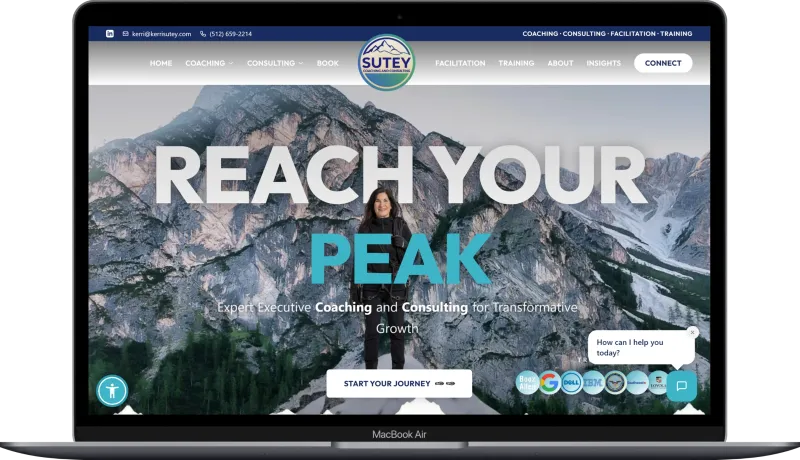
Kerri Sutey Coaching & Consulting
Executive Coaching · Professional Services
A template site became one connected brand, publishing, booking, and discovery platform.
Read the Kerri Sutey Coaching & Consulting case studyA general assistant knows a lot about the world and nothing specific about your business. We build the chatbot around your approved material and your rules for what it should and should not answer, with a handoff to a person when it reaches its limit.
It says so and hands over. We design the fallback first: what details it collects, where the conversation goes and who picks it up. A good handoff beats a confident wrong answer.
Not always. If your pages do not answer the basic questions yet, clearer pages may help more. AI is available when it serves the brief, and we will tell you if a chatbot is not the right first step.
Kerri Sutey's platform places a chatbot alongside service content and booking, and the Fusion Events site includes a chat concierge on its act pages. Both case studies are on our site.
Our project tiers are Starter at $2,500–$5,000 CAD, Professional at $5,000–$15,000 and Enterprise at $15,000+. A focused website assistant can fit the Starter tier; connecting it to booking, a CRM or internal systems adds scope. Payment is 30% upfront and 40% after you review progress at the midpoint.
Starter projects typically take 2–4 weeks and Professional projects 4–8 weeks. The free 30-minute call is the place to work out which one your idea is.
We configure it around approved business material and, where required, controlled access to existing systems. That differs from letting it browse anything and improvise. Your team identifies the authoritative sources, checks gaps, and approves the answers and escalation rules before launch.
No system can promise zero incorrect answers. We reduce risk through approved sources, limited scope, testing, and a clear fallback when information is missing. For sensitive questions, the assistant should hand off to a person rather than guess. Your team also needs a way to review and correct recurring issues.
Yes, where the platform provides suitable access. We separate answering questions from actions such as creating an enquiry or looking up a booking. The scope defines permitted fields, authentication, confirmation, and failure handling for each connected tool.
Knowledge preparation, channels, connected tools, authentication, conversation volume, and review requirements affect the scope. A website guide is a different build from an authenticated support assistant. We also identify recurring model and hosting costs so the launch quote is not the whole operating budget.
We build focused internal tools for problems that generic software handles badly or not at all.
We build bounded agents that monitor, prepare, route, and act with clear permissions and logs.
We connect AI capabilities to existing business systems with clear data paths and failure handling.
Tell us about the AI chatbots work you have in mind. We will come back with next steps, or a straight answer if a simpler tool would do the job.
Book a free 30-minute call